At some point in the life of almost every scaling SaaS company, a version of this conversation happens in a leadership meeting. The product function is growing. The founder is stretched. The team needs clearer direction. Someone says: “We probably need a CPO.” And then the room gets quiet, because nobody is quite sure whether that means hiring a full-time executive or bringing in fractional support — or what the real difference between those two options actually is.This article is for that conversation. It is a direct, honest comparison of the two models across eight dimensions that matter to UK SaaS founders: cost, speed to contribution, risk, board confidence, team impact, strategic output, AI integration, and long-term fit. The goal is not to sell one model over the other. It is to give you the information you need to make the right decision for your specific stage and situation.
The Starting Point: What Both Models Are Actually Trying to Solve
Before comparing the two approaches, it is worth being precise about the problem they are both trying to solve — because the problem definition determines which solution fits.The problem is this: your product function needs senior leadership. Not more PMs. Not a better project management tool. Not a new framework for prioritisation. Senior, experienced, strategic leadership that can set direction, develop the team, drive execution, and represent product credibly to the board and to investors.Both a full-time CPO and a Fractional CPO can provide that leadership. The question is which model provides it more effectively, at what cost, and with what risk profile, given where your company is right now.
Dimension 1: Cost
This is usually the first comparison founders make, and it is worth being specific rather than vague about the numbers.A full-time CPO in the UK at Series A to Series B stage typically commands a base salary of £140,000 to £200,000 per year. Add employer
national insurance contributions, pension, private healthcare, equity (typically 0.5 to 1.5 percent at this stage), recruitment fees if you use a search firm (typically 20 to 25 percent of first-year salary), and the fully-loaded annual cost of a full-time CPO hire in the UK is usually between £200,000 and £280,000. That is before the ramp period during which you are paying full cost for partial contribution.A Fractional CPO engagement in the UK typically runs between £4,000 and £8,000 per month depending on seniority, scope, and time commitment. At three days per week over a six-month engagement, the total investment is in the range of £24,000 to £48,000. That is 12 to 20 percent of the annualised fully-loaded cost of a full-time hire.The cost comparison is not close. For a company that genuinely needs CPO-level capability but is not yet at the revenue or team size that justifies a full-time executive, the fractional model is dramatically more capital-efficient.The important caveat: if you are at a stage where you genuinely need full-time strategic product leadership — where the volume and complexity of the decisions the CPO will face require their presence every day — then the fractional cost saving is a false economy. You are buying 60 percent of the resource you need and wondering why you are not getting 100 percent of the result.
Dimension 2: Speed to Contribution
This is the dimension most founders underestimate when planning a full-time CPO hire.A full-time CPO hire takes time. Finding the right person through a search process — whether using a recruiter, a network, or direct sourcing — typically takes three to five months at the CPO level. Add a notice period of one to three months for a senior executive leaving another role. Then add the genuine ramp time: the period during which the new CPO is learning your company, your market, your team, and your existing strategy before they are operating at full contribution. For a role as senior and context-dependent as a CPO, genuine ramp time is typically three to four months.From the moment you decide you need a CPO to the moment they are operating at full contribution: six to twelve months is a realistic timeline for a full-time hire.A Fractional CPO engagement, by contrast, starts with a two-week discovery sprint and is typically running at full contribution by week four. The reason for this speed difference is not that fractional leaders work faster — it is that they bring a structured diagnostic approach that compresses the learning period, and that they have typically done this specific thing many times before in many different contexts.If your product function needs senior leadership now — not in six months — the fractional model is the only option that can actually deliver it in the required timeframe.
Dimension 3: Risk Profile
Hiring a full-time CPO is one of the highest-risk executive decisions a founder makes. The role is deeply context-dependent — what makes a great CPO at one company can be exactly wrong for another. The assessment process is genuinely difficult because the skills being evaluated are strategic and interpersonal, not technical. And the cost of a bad hire is significant: a CPO who does not work out after six months has cost the company twelve to eighteen months of momentum in addition to the direct financial cost.The fractional model significantly reduces this risk profile in two ways.First, the engagement is bounded. If the chemistry is wrong, if the approach does not fit the company culture, or if the diagnosis in the discovery sprint reveals that a different kind of support is actually needed, the engagement can be restructured or ended without the financial and reputational cost of an executive departure.Second, a good Fractional CPO uses the engagement period to help the company understand exactly what profile they need in a full-time leader — the specific experience, the specific leadership style, the specific product domain expertise. The fractional engagement becomes the best possible preparation for a successful permanent hire.This is not a theoretical benefit. In practice, companies that bring in a Fractional CPO before making a full-time hire consistently make better permanent hires because they know their own product function much more clearly by the time they are evaluating candidates.
Dimension 4: Board and Investor Confidence
This is a dimension that does not get discussed enough in the fractional versus full-time debate, and it matters for fundraising.Some boards and investors prefer the signal of a full-time CPO appointment. A named executive on the leadership page, a LinkedIn profile with the company in the header, a presence in board meetings as a permanent team member — these signals carry weight with some investors, particularly at Series B and beyond.It would be dishonest to pretend otherwise. If your lead investor has explicitly said they want to see a full-time CPO hire as a condition of the next round, that is a real constraint that the fractional model does not fully address.However, two things are worth noting. First, the signal that most investors actually care about is not the employment status of the product leader. It is the quality of the product strategy, the reliability of the delivery, and the coherence of the metrics story. A Fractional CPO who produces all three is more persuasive to most investors than a full-time CPO who produces none of them. Second, a Fractional CPO who is visibly embedded in the leadership team — attending board meetings, presenting the product strategy, accountable for product OKRs — carries significantly more credibility than most founders expect.The honest answer is that board and investor confidence is case-by-case. Ask your investors directly what they expect, and factor that into the decision.
Dimension 5: Team Impact
A Fractional CPO and a full-time CPO both provide leadership to the product team. The nature of that leadership is different in ways that matter.A full-time CPO is present every day. They can build relationships with PMs over months and years. They are there for the difficult conversations that arise unexpectedly on a Thursday afternoon. They can observe team dynamics continuously and make adjustments in real time. For a large product organisation — ten or more PMs across multiple product lines — the scale and continuity of this presence is genuinely necessary.A Fractional CPO works differently. They are present intensively — typically three days per week — but not every day. They compensate for the gaps in presence with structure: a clear operating cadence, documented decision frameworks, and a coaching approach that builds PM capability rather than creating dependency on the leader’s judgment. The goal is a team that is more capable at the end of the engagement than at the start, not a team that runs well only when the leader is in the building.For a product team of two to eight PMs, the fractional model is typically sufficient to provide the leadership quality the team needs. Below two PMs or above eight, the calculus changes.
Dimension 6: Strategic Output
Both models should produce the same core strategic outputs: a clear product vision, a prioritised and outcome-based roadmap, a metrics framework that connects product work to business outcomes, and an operating model that can sustain consistent execution.The difference is in how these outputs are produced and sustained.A full-time CPO builds the strategic layer once and then maintains it continuously as the company evolves. The strategy is a living document that they update as the market shifts, as new customer evidence arrives, and as the team’s capability grows.A Fractional CPO builds the strategic layer during the engagement and designs it to be self-sustaining after they leave. The strategy is a more explicit artefact — a written document, a decision framework, an operating playbook — because it needs to work without the continuous presence of the person who built it.Both approaches can produce excellent strategic output. The fractional approach tends to produce more explicit, documented strategy — which is sometimes more useful than a strategy that lives primarily in a single person’s head.
Dimension 7: AI Integration
This dimension is increasingly relevant in 2026, as the ability to integrate AI strategy into product leadership has become a genuine differentiator between product organisations.Both a full-time CPO and a Fractional CPO should be capable of leading an AI integration strategy — evaluating where AI creates genuine ROI in the product, building the roadmap for AI initiatives, and developing the team’s AI literacy. The relevant question is whether the specific individual you are considering has done this before in a context similar to yours.One practical observation: because Fractional CPOs typically work across multiple companies simultaneously, they often have more current and diverse exposure to AI integration patterns than a full-time CPO who has been embedded in a single company for two years. This cross-company pattern recognition can be a genuine advantage when evaluating AI opportunities.
Dimension 8: Long-Term Fit
The fractional model is not a permanent solution. It is a high-leverage intervention for a specific stage and a specific set of problems. The honest question is not “fractional versus full-time forever” but “what does my company need right now, and what will it need in twelve months?”For most Series A companies, the fractional model is the right immediate choice — it provides the strategic leadership the company needs without the cost, risk, and timeline of a full-time hire, and it creates the conditions that make a future full-time hire successful.For most Series B companies and beyond, the balance shifts. The volume and complexity of product decisions, the size of the product organisation, and the expectations of investors at that stage typically make a full-time CPO the right next step. The question then becomes not whether to make the hire, but whether the product function is ready to receive them — and a Fractional CPO engagement is often the best way to get it ready.
The Decision Framework: Eight Questions to Ask Yourself
If you are trying to decide between fractional and full-time, these eight questions will give you the clearest answer:
One. How urgent is the need? If you need senior product leadership in the next four weeks, the full-time model cannot deliver it. If you can wait six to twelve months, it is worth considering.
Two. What is your current ARR and runway? Below £3 million ARR, the fully-loaded cost of a full-time CPO hire represents a meaningful percentage of annual revenue. The fractional model is almost always the right choice at this stage.
Three. How large is your product team? Two to eight PMs — fractional is typically sufficient. More than eight — full-time is probably justified by team size alone.
Four. What has your board explicitly asked for? If they have asked for a named full-time executive, that is a real constraint. If they have asked for stronger product leadership, that is a different question.
Five. Is your product function ready to receive a full-time CPO? If the operating model is chaotic, the strategy is unclear, and the PM team is underdeveloped, a full-time CPO will struggle regardless of how good they are. Fix the foundation first.
Six. Do you know exactly what profile of full-time CPO you need? If not, a fractional engagement will help you find out — which makes the eventual permanent hire significantly more likely to succeed.
Seven. What is the cost of getting this wrong? A failed full-time CPO hire costs twelve to eighteen months of momentum and six figures in direct cost. A fractional engagement that does not work out costs one to three months of investment and a frank conversation about what to do differently.
Eight. What does your next twelve months require from the product function? Be specific. If the answer is “survive and stabilise,” fractional can absolutely deliver that. If the answer is “scale a 20-person product organisation across three product lines,” you probably need a full-time leader.
The Honest Conclusion
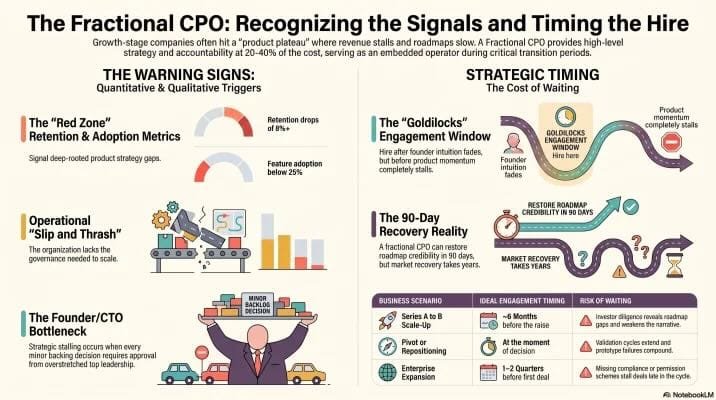
There is no universal answer to the fractional versus full-time question. The right choice depends entirely on your company’s stage, size, ambition, and constraints.What is true is that most UK SaaS founders at Series A make this decision too slowly and with too little information. They know they need something but spend six months in indecision — which is the worst possible outcome. The product function operates without the leadership it needs while the decision is being made.If you are showing two or more of the six signals described in our companion article on when a SaaS startup needs a Fractional CPO, the right move is to act now rather than wait for perfect clarity. A two-week discovery sprint with a Fractional CPO will give you more clarity about what your company actually needs than six months of deliberation.The cost of that clarity is significantly lower than the cost of another quarter without it.Want to think through which model is right for your stage? Book a free 30-minute strategy call at
elvanis.com. We will give you a direct, honest recommendation — even if the answer is that a full-time hire is the better path.
Sally Abas is the founder of Elvanis and a Fractional CPO with 18+ years of experience across SaaS, fintech, e-commerce, and enterprise transformation. She has worked with 50+ companies across 9 countries.Related reading: When Does a SaaS Startup Actually Need a Fractional CPO? |
What a Fractional CPO Actually Does in the First 90 Days |
When a Fractional CPO Makes Sense: ROI, Timing, and 3 Signs You Need One