Most companies racing to add AI features to their products are solving the wrong problem. A chatbot that nobody uses. A “smart” recommendation engine that recommends the wrong things. An AI-powered dashboard that the team ignores after two weeks.
The technology wasn’t the issue. The strategy — or the absence of one — was. Identifying and removing AI Product Strategy Bottlenecks is the key to moving from a “feature factory” to a scalable, high-ROI AI product engine.
In 2026, the market leaders won’t be the companies with the most AI features. They will be the companies where AI execution is tightly aligned with their core business goals, their data infrastructure is solid, and their teams are built to iterate fast.
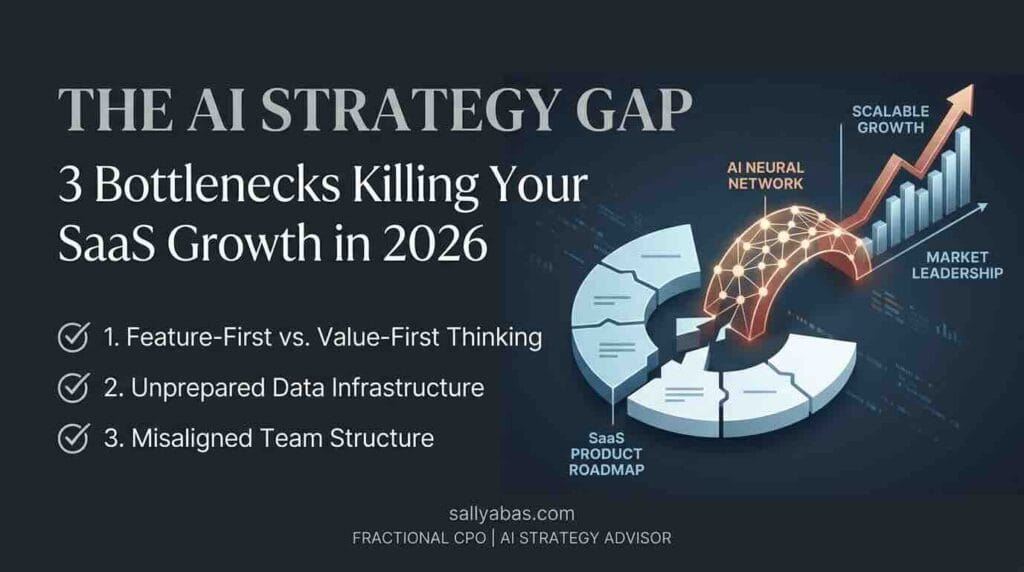
After working as Fractional CPOs across 50+ companies in 9 countries, we see the same three bottlenecks appearing again and again. If your AI initiatives are stalling, one of these three bottlenecks is almost certainly the root cause.
These bottlenecks are often the symptoms of a wider AI Product Strategy Gap, where technical execution fails to meet business expectations.”
At a glance
Bottleneck 1 – solving the technology before the problem: deploy AI only where it gives a measurable improvement in user experience, and use an opportunity audit to stack-rank your highest-friction workflows.
Bottleneck 2 – building AI on messy data: answer three data readiness questions before investing in a model.
Bottleneck 3 – an organisation not structured for AI development: check for shared language, critical evaluation and executive sponsorship, and run a one-hour AI sprint kickoff.
Bottleneck #1: Solving the Technology Before the Problem
The most common AI strategy mistake we see isn’t a technical failure — it’s a prioritisation failure. It is one of the most expensive bottlenecks because it wastes engineering cycles on “cool” demos rather than customer value.
AI should only be deployed where it provides a 10x measurable improvement in user experience. If you can solve the problem with a cleaner UI or a simpler workflow — don’t use an LLM.
The Fix: Conduct an opportunity audit. Stack-rank your highest-friction user workflows by potential impact. Only the top two or three deserve AI investment this quarter. A good strategy is about having the discipline to ignore the hype.
Bottleneck #2: Building AI on a Foundation of Messy Data
You cannot build a reliable AI product on top of inconsistent or poorly governed data. Fragmented data leads to fragmented AI outputs. In our experience, technical debt in your data layer is one of the hardest bottlenecks to overcome post-launch.
The three data readiness questions every founder needs to answer:
Is our product data clean and centrally accessible?
Do we have defined data ownership?
Can we run controlled experiments to isolate impact?
If the answer is “no,” your first investment should be in data infrastructure — not a new model. Commissioning a two-week data audit can prevent months of wasted engineering time caused by these underlying data problems.
Bottleneck #3: The Organisation Isn’t Structured for AI Development
AI development is iterative and non-linear. Traditional waterfall product management often creates organisational bottlenecks by requiring rigid documentation for a process that thrives on rapid experimentation.
The three organisational readiness signals:
Shared language: Does the team agree on what “AI-ready” means?
Critical evaluation: Can your team see past a vendor’s hype?
Executive sponsorship: Is leadership actively championing adoption?
The Fix: Run a one-hour “AI sprint kickoff” to establish the hypothesis and the failure threshold. This practice bypasses common organisational bottlenecks by ensuring everyone is aligned on the “why” before the “how.”
Overcoming AI Product Strategy Bottlenecks: Features vs. Strategy
At the root of these issues is the mistake of treating AI as a feature category rather than a strategic capability. When you treat AI as a feature, you build based on novelty. When you treat it as a strategic capability, you build based on your long-term competitive moat.
In 2026, winning companies are those that proactively identify their bottlenecks and choose to build deliberately.
How to Audit Your AI Product Strategy Bottlenecks This Week
If you recognise these patterns, here is your action plan:
Audit your roadmap: Pause any AI item that doesn’t have a specific success metric.
Map your data: Identify siloes before your next build begins to avoid data problems later.
Launch a sprint kickoff: Define your failure threshold to ensure you don’t chase “sunk costs.”
Frequently Asked Questions
What are the three AI product strategy bottlenecks?
They are solving the technology before the problem, building AI on a foundation of messy data, and an organisation that isn’t structured for AI development. Each is covered above with a practical fix.
How do we know if our data is ready for an AI feature?
Ask three questions: is our product data clean and centrally accessible, do we have defined data ownership, and can we run controlled experiments to isolate impact? If the answer to any of them is no, the first investment should be in data infrastructure rather than a new model. A two-week data audit is a sensible place to start.
What is an AI sprint kickoff?
It is a one-hour session to establish the hypothesis and the failure threshold for an AI initiative, so that everyone is aligned on the “why” before the “how”.
If you’re not sure which bottleneck is limiting your growth, a structured diagnostic can provide the clarity you need.
Need to fix what is actually blocking your AI roadmap?
Our AI Strategy & Advisory service helps teams evaluate use cases, improve readiness, and align product, data, and leadership before AI work becomes expensive noise.
Related reading:
Read Why Most AI Features Fail: The Product Strategy Gap Behind Weak Adoption for the strategic foundation behind the bottlenecks covered here. You may also find Why Your Product Prioritisation Framework Isn’t the Problem useful if the real issue is how priorities get decided.
Get tailored next steps:
Take the 5-minute Product & AI Readiness Assessment and receive a personalised report on where your team is most likely getting stuck.
Schedule a free 30-minute strategy call to identify which AI Product Strategy Bottlenecks are currently stalling your roadmap.